Love Can't Be Unrequited (even if it feels that way)
Relational longing, and the frequency of embodied love.
Hello friends,
A few days ago, I was walking with my family through the Alhambra. Taking in the impossible delicate geometries, the light filtering through cut-out stars, and the vast terraced gardens. I commented to my daughter how my ex would have noticed and delighted in everything here, with more than a little longing in my voice. She simply took my hand and said,“Wouldn’t it be wonderful if we could only have the good parts of them? Just the magical bits where we see their soul light?” We walked on quietly. Yes, that. And also just feeling the love for all of our people, without having a place for it to land, and allowing it to be just so.
Maybe you also know this longing for one who can’t meet you. For a union or intimacy that stays just out of reach. Or maybe it is a longing for some permanency, imagined safety, or even for god(dess). The heart doesn’t distinguish between these, really: they are in many ways the same ache.
So today I am sharing the perspective of nondual Tantra on this matter, something that when I touch it in my personal experience brings true bliss in the being: There is another plane entirely, a love so permanent and deep, a way of being that isn’t tied to another’s choice to respond.
Also, I would love to hear from you, on what you are enjoying in the work, what’s resonating, what you would like more of.
Other Notes: Tomorrow is our monthly Good Community Gathering at 10 am Pacific time. Upcoming: The Yearn in Mexico, then 3 back to back programs in Portugal: Bhakti Immersion with Adam Bauer (one shared female room remaining), The Holomovement, and Body of Joy with Will Keepin and Cynthia Brix.
All Love, and see you tomorrow.
Christine
The TLDR for this week:
The ache for a person, for union, for god — the heart doesn’t distinguish, it’s the same longing
When we fall in love, we access a version of ourselves that’s more awake, more generous — and we grieve that self when it ends
The beloved occasions the love, but doesn’t source it — what can be occasioned can be known directly
Long-arc entanglements are curriculum: the soul selects exactly the mirror it needs
Pratyabhijñā: consciousness moves freely, from itself, without requiring an object
When you hold personal longing as universal human frequency, the sting drops out — only vast empathy remains
Tirumular: love and Shiva are not two; abide as love, which is Shiva itself
Love cannot be unrequited — it arises in you, whole, and moves outward
Rest as love. Take no action but that.

When we fall in love, the ordinary film of habit and judgment lifts. We look at another person and notice everything: we see their particular genius, their specific beauty, the way their mind moves. We are generous without effort. We seem to see from a different place in ourselves, as if love cracks opens a capacity in us for more attention, delight, and presence. We feel more spacious inside and more awake.
And of course, there is the gift of being seen that way in return: received fully, held without condition, witnessed in the strange particular truth of who we are. Under this gaze, I find there is somehow more breathing room in myself.
So when the flush of relational “in-love-ness” ends, we grieve both the other person, and also the version of ourselves we were when we were with them.
Once, when I found myself longing to be met by a specific person who couldn’t return the affection, what I would have once called unrequited love, a friend gave me this jaw-dropping line: “How beautiful that you can generate that love inside of yourself.”
That is to say:the bliss of seeing, of loving, of being alive to beauty may be occasioned by another being. And what can be occasioned can be known directly, without the occasion.
Being in love is object independent: it arises in and as me.
So I started to explore this, and have found it to be both true in my own experience, and pointed to by the ancient texts of my tradition.
The beloved is the occasion, but they aren’t the source.
Those of us who have had the tendency to lean out for love (hat tip to Leonard Cohen), who learned to locate love outside the self, or perhaps learned that warmth had to be earned might disagree with this. We might say, “This is a nice idea, but my experience is painful, so take your spiritually bypassing ass and leave me with my romantic-erotic longing, I trust that, even with the pain it is bringing, it’s doing something for me.” Okay I get that. I sometimes feel that.
In that reaching, though, our attention, our energy and center of gravity tilt outward.
Long arc unresolved entanglements are a curriculum. Something in us (generously, the soul’s intelligence) selects for the person who mirrors exactly the pattern that most needs to be seen. The entanglement and repetition are trying to get through to a deeper layer of our soul work in this lifetime. And there are the grooves worn into consciousness by repeated experience, by the body’s memory, by lifetimes (samskaras). A single insight doesn’t erase a groove. The groove has to be met, again and again, until the charge releases. So we stay. Or we leave and return. Or we leave and find the same person in a different body.
The question to sit with is what is this entanglement trying to complete. What is wanting to be seen, metabolized, released. When that becomes clear, the entanglement either transforms or dissolves. Both are resolution.
AND, anytime we find ourselves over-extending away from our own center, chasing the feeling of being seen, outsourcing our own aliveness, we return. Come back to Aham Shakti. The recognition that the power is ours. That the quality of loving we found in their presence lives in us, not in them. Sit back. Be the love.
In a non-metaphorical and direct experience way I can report: there is another plane entirely.
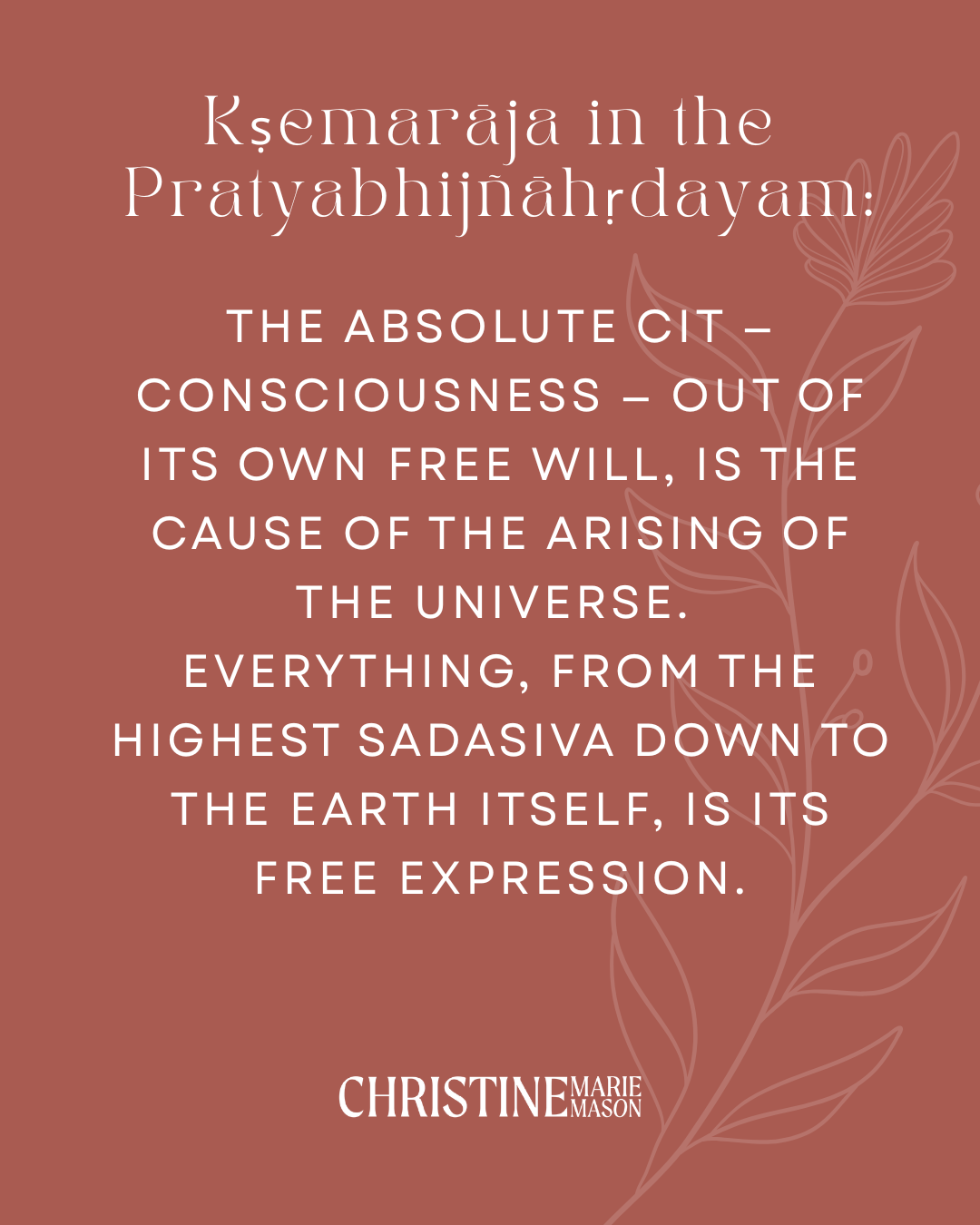
Kṣemarāja opens the Pratyabhijñāhṛdayam with this: The absolute Consciousness — out of its own free will, is the cause of the arising of the universe. Everything, from the highest Sadasiva down to the earth itself, is its free expression.
Out of its own free will. Consciousness does not require an object to express itself. It moves freely, from itself, as itself. The relational plane lives fully inside that same consciousness. The personal and the universal are not two altitudes of experience. They are the same energy, expressing itself at every level of manifestation at once.
When I hold the longing for another not as my personal story but as a human frequency, it shifts. When I practice seeing my personal experiences as universal experiences, archetypal across time and space, something amazing happens. The self that is yearning becomes the Self that recognizes this ache in every human heart that has ever loved. All longing, all heartbreak across the planet echoes here in my heart. With this practice, there is no more sting, only gentleness. Only a vast empathy for all of us, reaching toward each other, trying to stay open.
Love is a frequency, a field, a quality of consciousness and we are already inside it. The one we long for is an occasion for that frequency to move through us. When we locate love in the relationship, in the story of the lover and the beloved, we make it conditional, small.
When we locate it in ourselves as a frequency field, it becomes the essence of our being.
So when the feeling arises in me, I enjoy it, I admire their beauty, I bask in the awe I feel, the chemicals coursing in my body, the flush of crush, and I take no action but to rest as love.
Tirumular said it in four lines:
அன்பு சிவம் இரண்டு என்பர் அறிவிலார்,அன்பே சிவமாவது ஆரும் அறிகிலார்,அன்பே சிவமாவது ஆரும் அறிந்தபின்,அன்பே சிவமாய் அமர்ந்திருந் தாரே.
“Those without wisdom say love and Shiva are two. None know that love itself is Shiva. When one comes to know that love itself is Shiva, one simply abides as love, which is Shiva itself.”
In Bhakti, the yoga of devotion, we say that the lover who longs without trying to possess is practicing the purest form of love. The sacred longing is the heart of devotion. The bhakti traditions say the longing and the ache are real, and that this longing eventually burns through the story of the separate lover until what remains is love itself.
Love cannot be unrequited. It arises in us, whole, and moves outward. What the other does with it is their story.
Here, we rest.
Anbe Shiva.