The Great Awakening: Part 1/4
The Fracturing Cosmology at the Edge of Evolution
Hi everyone,
Thanks for being with me in this journey of inquiry, and welcome to all the new people from this week’s Coming Home summit and the Holomovement 2026. For those who don’t know me well, my work sits at the intersection of consciousness, embodiment, spirituality, feminine development, leadership, and cultural evolution. I am unusual in that I come from both the tech world and the contemplative/spiritual world, and much of my writing attempts to integrate those domains. I’m a mother and a yogi, and the founder of Rosebud Woman, with a deep love for beauty, for the exquisite wondrous, enchanting beauty of this given life. I circle around this idea in different ways: human flourishing comes through deeper embodiment, expanded consciousness, reverence for life, and the integration of spiritual insight with practical action in the world.
In this new series of essays, I ask: beneath today’s political, technological, and cultural conflicts, what is happening to human consciousness itself? I see four broad responses emerging. Some want to transcend biology through technology. Some want to return to land, embodiment, and traditional forms of life. Some continue to trust that existing institutions can restore stability. Others are exploring consciousness directly through contemplative practice, psychedelics, intuition, and altered states.
Though these movements appear unrelated, they may all be responding to the same underlying pressure: an increasingly mediated world in which reality reaches us through screens, algorithms, and abstractions rather than direct experience.
Drawing on Karl Jaspers’ idea of the Axial Age, I suggest we may be living through another civilizational threshold: not simply a political or technological transition, but a reorganization of consciousness itself. The growing fragmentation around us may be less a sign of collapse than of a system exploring multiple futures at once, searching for what comes next.
For those of you looking to dive deeper with me in the coming year, my next immersion dates have been set: November 1-22, 2026 Living Tantra Immersion on the Big Island of Hawai’i (come for all or part); March 10-22, 2027, Cambodia (Devotional adventure, ending on the Spring Equinox over Angkor Wat temple); March 26-29, 2027, Mystic Heart of Easter , in Southern California. Living Tantra level 1 and 2 will be held in September and October, 2026, and the sexuality and breathwork units are on the schedule for the Spring of 2027.
Sending my deepest love and looking forward to your comments on this new series,
Christine Marie
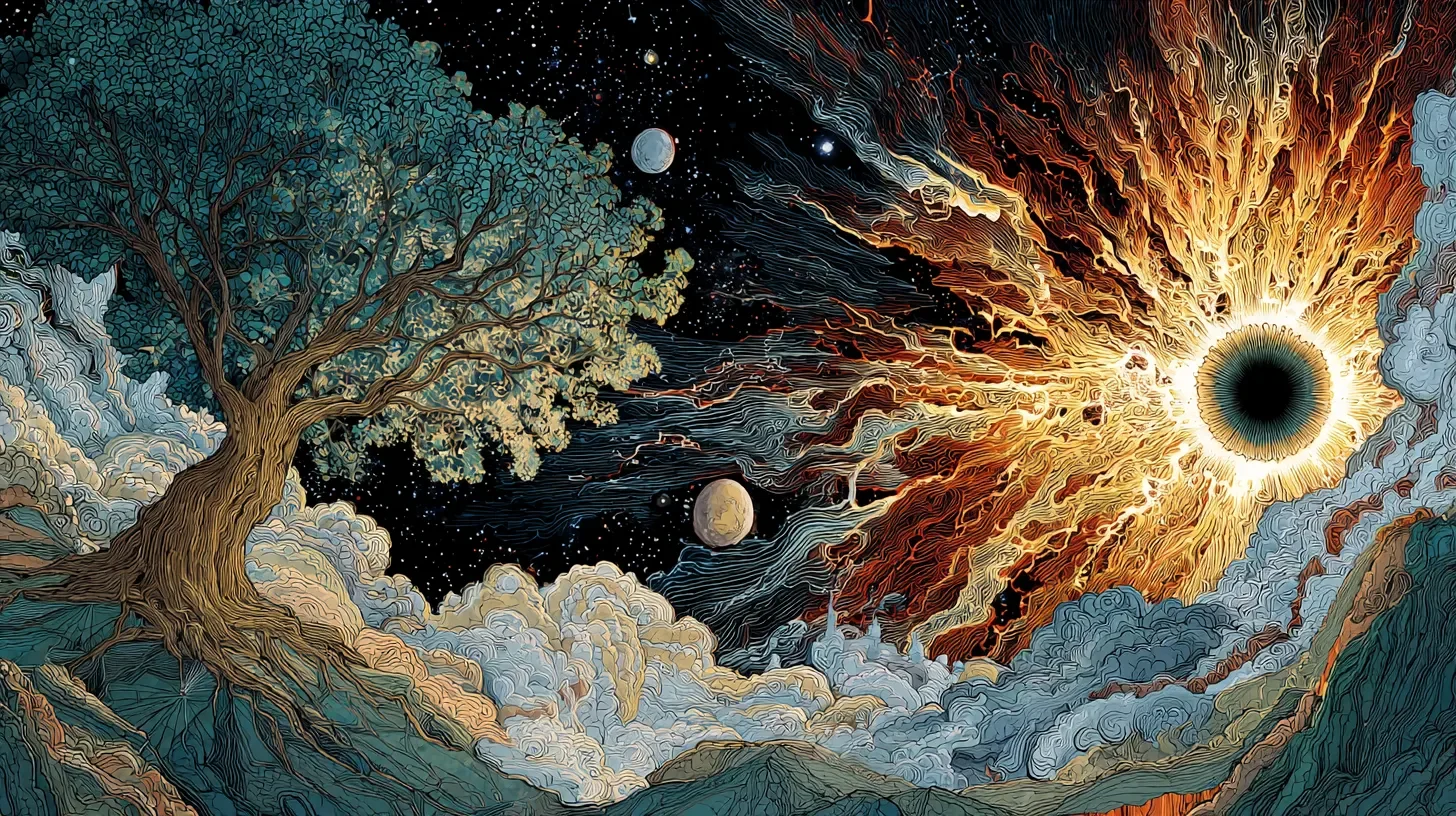
In my circles—global, varied, and unusually broad—the conversations people are having to make sense of the world have shifted dramatically over the past few years. I have a growing sense that something is reorganizing at the level of the human nervous system itself, beneath politics and deeper than culture. The surface arguments are different, but they orbit the same underlying question: what are we becoming?
One group is oriented toward leaving.
These are the people who have decided that Earth is a limitation: too slow, too biological, too constrained by death, gravity, and the inconvenient needs of bodies. They are headed toward space, brain-computer interfaces, digital consciousness, the singularity, whatever comes after the human. This is usually articulated in the language of progress and innovation, but its bones are older. The body as a carceral prison. Gnosticism with better funding, matter as the demiurge, and a sort of secular transcendence: consciousness uploaded into light, finally freed from the burden of its stinky farty body.
Another group is oriented toward return.
They are restoring, re-rooting, landing back in organic reality. They are rejecting screens, reducing their dependence on algorithms, learning to make things with their hands again. Growing food. Firing clay. Yet this, too, can harden into ideology, and a different kind of exit. Plus it lives inside the cage of the modern supply chain: the hand tools, solar generators, and Carhartts are still purchased online; the veggies artistically photographed for Instagram. They are running toward the past rather than toward the machine, while unable to fully escape the machine. It also has a whiff of escapism (and a little aesthetic cosplay).
A third group is neither leaving nor returning, it’s simply not looking.
This is the world of business as usual, where another election cycle, policy proposal, or fundraising campaign is expected to nudge the system back onto its familiar tracks. Yet increasingly, that confidence feels disconnected from reality. Many of the frameworks that organized the last century such as nation-states, economic models, political institutions, even shared narratives of progress are failing now, as the world they were built to manage for swiftly outpaces their capacity to regulate or respond.
And then there is a fourth movement, harder to name. It appears in conversations about consciousness, contemplative practice, psychedelics, intuition, remote viewing, nervous-system development, and what some describe as a species-level transition. It’s populated by people who report experiences that challenge conventional assumptions about mind and perception: moments of non-local knowing, unusual synchronicities, altered experiences of time, or a persistent sense that something previously hidden is becoming more visible.
It doesn’t matter whether every claim emerging from these spaces is true or verifiable Much of it almost certainly is not. What matters is that increasing numbers of people feel the standard model of mind, self, and consciousness is no longer sufficient to account for their experience. Something is changing in how people understand consciousness and in how they experience it.
The people drawn toward these explorations often speak with a peculiar mixture of conviction and hesitation. They sense a shift but lack a shared language for describing it. They understand how implausible many of their experiences sound within the dominant worldview, yet they continue because those experiences have become increasingly difficult to ignore. So people reach for provisional language: I have heard what’s happening described as a consciousness shift, a species threshold, a splitting, an awakening, an evolutionary leap.
The fracturing we are witnessing is what a system looks like under evolutionary pressure, exploring the edges of what its current form can hold, searching for the shape of whatever comes next.
People are building futures from deeply unexamined positions and assumption, with fundamentally different ontologies, such as:
What is the body for?
What counts as real?
Is Earth a home or a constraint?
Is the human form an endpoint or a beginning?
What is time?
Is death a problem, or the deepest teacher?
The conflicts exist at the level of first principles. Debate about what kind of a future we are creating assumes a shared worldview. Increasingly, that common ground no longer exists. In these next few weeks, I want to talk about some of these questions, and see what we might discover together.
A Pressure With a Name
We have been here before, though not here exactly. The philosopher Karl Jaspers called it the Axial Age: roughly 800 to 200 BCE, when human consciousness appeared to reorganize itself across multiple civilizations almost simultaneously. The Buddha. Socrates. The Hebrew prophets. Lao Tzu. Confucius. The seers of the Upanishads. Though separated by geography and culture, they arrived at a similar discovery: interiority. The individual moral self. The realization that there was an inner domain no bureaucracy could fully administer.
Why then? Because increasing civilizational complexity had generated unprecedented pressures. Cities, empires, writing systems, trade networks, abstraction, administration. Human beings were being asked to operate at a scale that exceeded the assumptions of older ways of life. Consciousness reorganized in response.
One of my professors at CIIS, Sean Kelly, whose work on integral ecology and the emerging planetary era has profoundly shaped my understanding of this moment, is among those who have suggested that we may be entering a second transformation of comparable magnitude. Not merely a cultural shift, but a reorganization of consciousness itself—one driven by pressures as unprecedented as those that gave rise to the first Axial Age.
This time the pressure is not empire, or literacy, but mediation.Nearly every layer of modern life now arrives filtered through technological systems: screens, algorithms, feeds, metrics, simulations, predictive models, representations of representations. Our experience of reality increasingly reaches us through layers of interpretation before it reaches us directly. Digital turtles all the way down.
Decades ago, Marshall McLuhan argued that media technologies do not simply deliver information; they reshape perception itself. More recently, Iain McGilchrist has described how modern societies privilege modes of attention oriented toward abstraction, control, manipulation, and representation, often at the expense of more embodied, relational, and participatory ways of knowing. Whether or not one accepts these theories in full, the pattern is difficult to ignore.
As mediation expands, so does the hunger for immediacy.
This may be one reason so many people are turning toward practices centered on direct experience: meditation, somatic work, ecological immersion, contemplative traditions, ritual, psychedelics, and forms of consciousness exploration that sit uneasily within conventional frameworks. The specifics vary, but the impulse beneath them is remarkably consistent.
People are searching for contact. Not information about reality, but reality itself. Real encounters. The actual territory, taste, flavor.
Seen from this angle, many of the movements of our time come from the same underlying pressure: the technologist seeking transcendence, the homesteader seeking reconnection through land, the contemplative seeking direct awareness beneath thought. Tantra codes it this way: the deeper the veil of māyā, the stronger the pressure toward recognition. Concealment and revelation belong to the same movement. The contraction creates the conditions for the breakthrough. The pressure is not separate from the transformation.
In Part 2, I dive deeper into some of the core fracture points, or veins of thought, that underpin our worldviews, and invite inquiry into how malleable those are, including time, mortality, legitimacy, sacredness, relatedness, the feminine, grief, and even AI.