
The Whole Beautiful, Bewildering Animal
On changing bodies, the just-world hypothesis, and the difference between healing and cure
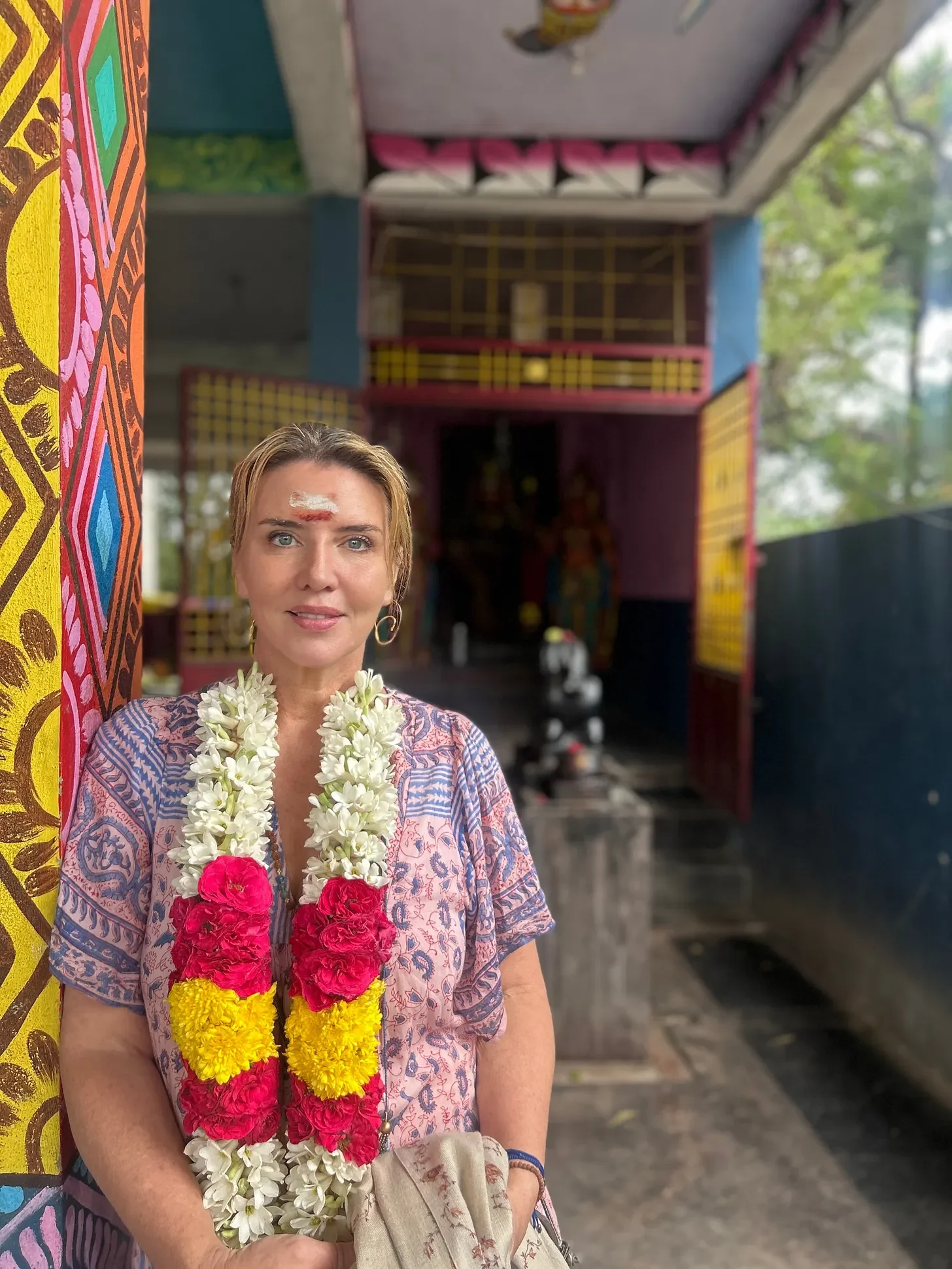
Tiruvannamalai, India, January, 2026
Hello friends,
A health intake form came across my desk this week. Someone lovely, coming to a retreat, had filled it out with obvious care. She listed eleven medications, some for chronic conditions and some, I suspect, for the side effects of those, which is its own kind of story: a body being managed, one intervention creating the need for the next, each line the residue of years spent doing her best with a physiology that had other ideas. My first response was simple sympathy. What it must take to carry that. How much of the carrying stays invisible to everyone who meets her, and how many conversations she has probably abandoned partway through, having decided not to explain.
The longer I sat with the list, the less distant it felt. Because beneath the diagnoses and the prescriptions and the pharmacy schedule, chronic illness is the experience of a body changing without your permission. It is the loss of a certain kind of authorship over your own physical life, the quiet discovery that the thing you assumed you were driving has an itinerary of its own, and that you will be learning the itinerary as it happens rather than before.
I don’t know that experience as she knows it, but we have all visited that country. We have all had weeks when illness shrank life down to the single project of getting through the day. And those of us in female bodies know what it is to live in cycles, in a body that never wakes up quite the same. Something is always shifting without asking first. That sent me looking for what philosophers and contemplative traditions have to say about living in a body that keeps changing.
I’m in my last week of quiet languid staring at the ceiling before going back out into the world for the next round of teaching and speaking for Rosebud Woman and the Living Tantra Institute. I’ll be in California for most of August, then Hawaii, Montana, Nebraska and Tepotzlan in September and October, and finally landing back at Sundari for the remainder of the year. Please come to our Living Tantra Immersion runs November 1-22 on the Big Island. 1 to 3 week stays are possible. We have 2 rooms and 2 dormitory spots remaining.
Love
Christine
Wellness Perfectionism
Bring to mind a time when the body, unbidden, started doing something new. Three a.m. wakefulness, lying there doing arithmetic about how tired you will be. The word that disappears mid-sentence in a room where you are supposed to be the competent one. Joints that have developed opinions. A gut that has become unpredictable. Skin, digestion, temperature, desire…some system that used to run itself now requiring management, and a whole category of experience many who don’t want to hear about illness would rather you left undescribed.
Autoimmunity does this. So do injury, treatment and its aftermath, long COVID, menopause, and the ordinary arithmetic of a body accumulating years.
Bring any of it into the open and there are two common responses.
The first is a shrug. Everyone goes through it. This one arrives from physicians with fifteen minutes for a problem that needs an hour or from partners who would prefer a different subject. The shrug is not always careless. Some of it is self-defense. Anyone who has lived alongside a person who used symptoms as currency for attention or exemption can learn to go flat when a body complaint arrives, because engaging meant being conscripted. That flatness is a real adaptation, formed for real reasons. Yet it paints with too broad a brush, and colors the next person the same way, whether or not she has done anything to earn it.
The second response sounds considerably kinder. You wouldn’t be struggling so much if you’d optimized properly. If your hormones were dialed in, your cortisol regulated, your sugar gone, your sleep hygiene corrected, your macros dialed in with more discipline.
Susan Sontag dismantled that second way of thinking in Illness as Metaphor, which she wrote while undergoing treatment for breast cancer, surrounded by women who had been told their tumors were the fruit of repressed feeling. Her argument runs like this: once we assign a personal meaning to a physical condition, that meaning becomes moral, and the morality lands on the person. If your character somehow caused it, then failing to fix it becomes your fault as well, and you have been handed the disease and the guilt together. Her method was historical. She traced how tuberculosis in the nineteenth century had been romanticized as the affliction of sensitive, passionate souls, naming Keats, Chopin and the consumptive heroine. She connected that to cancer in the twentieth being moralized as the disease of the repressed, those who had failed to express. Both fantasies evaporated the moment the actual causes were understood, which tells you what the fantasies had been made of: the shape of our ignorance rather than any insight into the diseases. Theories that blame disease on mental states, she concluded, are “an index of how much is not understood about a disease.”1
Beneath the friendlier response sits a quiet fallacy: that the inputs determine the outcome. If I eat perfectly, buy the nontoxic products, manage my stress, take the supplements, do the practices, I will be spared.
Psychologists have a name for the instinct underneath. In 1966 the social psychologist Melvin Lerner and his colleague Carolyn Simmons ran an experiment in which observers watched a woman appear to receive painful electric shocks during a learning task. Some observers were told the suffering would soon end. Some were given the chance to vote to stop it. Some were told she would be compensated. And some were told simply that it would continue, with nothing they could do. The ones who could neither help her nor expect her suffering to stop rated her character significantly more harshly than any other group. They had no other way to keep the world intelligible, so they revised her worth downward instead. Lerner spent the next two decades developing this into what he called, in his 1980 book, the belief in a just world: a fundamental delusion that the world is orderly and fair and that people broadly get what they deserve.2
The delusion is load-bearing. We need some assumption of predictable consequence in order to plan anything at all, and the belief does real protective work every time it fires. It gives us a sense of order in a world far less controllable than we would like.
The trouble comes when the instinct turns inward, and the observer and the sufferer are the same person.
The moment your body does something unexpected anyway, despite your protein shakes and probiotics and deep breathing, as bodies do, from genetics and viruses and chance and time and the simple fact of being an organism, then the story turns on you. If good inputs produce good outcomes, then a difficult outcome must mean you failed.
You didn’t know enough. You didn’t do enough. You weren’t disciplined enough.
Notice, too, that the optimization story can never be wrong. If it works, the protocol takes the credit. If it doesn’t, you didn’t follow it closely enough, or you had resistance, or unprocessed trauma, or you weren’t ready. The framework is structurally unfalsifiable: the system cannot fail, only you can fail it. This is the architecture theology uses to preserve a good God in a world full of undeserved suffering, and wellness culture has substituted the body’s innate intelligence for the deity. The optimization story is a self berating contract.
The truth is more complicated, and it requires holding two things at once. The inputs load the dice, but they don’t roll them. Lifestyle is one of the biggest levers most people never fully pull, and still, the lever is not a guarantee. Both halves are true, and the second half is the one wellness culture cannot afford to say out loud, because the second half sells nothing.
This investigation brought me to the work of several writers and researchers.
Stephen Levine, who with his wife Ondrea spent decades accompanying the seriously ill and the dying, drew a distinction our culture rarely makes. Some people are cured and never heal. Others heal profoundly while their illness progresses toward its end. Healing, he came to understand, is a different thing from cure — it is the movement toward wholeness and an unarmored heart, and it is available in any condition whatsoever, including the ones with no good prognosis. “To heal is to touch with love that which we previously touched with fear,” he wrote.3 What gives his position weight is that he was writing in 1987, at the height of the you-created-your-illness vogue, and was unusually direct about its cruelty. He recounts a woman telling him that she had created her cancer and could not create her cure and therefore deserved to die, which is that doctrine arriving at its logical destination. None of this makes cure less precious. We seek it where we can, we pull every lever available. It means only that our wholeness cannot depend on the outcome of the seeking.
The philosopher Havi Carel, diagnosed in her thirties with a rare progressive lung disease and writing as both patient and phenomenologist, gave me language for why a changing body is so disorienting. Working from Merleau-Ponty’s distinction between the body as biological object and the body as lived, she observes that in health the body is transparent: we look through it at the world, the way you look through a clean window without noticing the glass. We don’t think about breathing until breathing becomes difficult, or about stairs until a knee declines to cooperate. Then something changes and the body becomes opaque. It enters consciousness. We are no longer simply living our lives; we are living with our bodies, which is a different and far more effortful activity. Her further point is that this constitutes a transformation of the lived world: distances re-map, time re-scales, a flight of stairs becomes a mountain, and the taken-for-granted gets revealed by its loss.4 Carel has also written about what she and the philosopher Ian James Kidd call epistemic injustice in healthcare, or the systematic discounting of ill people’s own testimony about their experience, which is why so many people describe leaving appointments feeling treated and unseen at the same time.
Toni Bernhard, who was a law professor at UC Davis until illness ended her career in 2001 and who has spent most of the two decades since largely confined, offers another insight. The image is the Buddha’s, from the Sallatha Sutta: there are always two arrows. The first arrow is the thing itself — the hot flash, the aching joint, the fog, the diagnosis — and the first arrow is frequently beyond negotiation. The second arrow is everything the mind adds to it. This shouldn’t be happening. Something is wrong with me. I am falling apart. I should be handling this better. Everyone else seems to manage. The sutta’s claim, which turns out to be empirically defensible, is that the untrained mind reliably shoots the second arrow into the wound made by the first, and that the second is where the damage compounds. Bernhard’s own contribution is the diagnosis underneath: behind every stressful thought, she writes, is “the desire for things to be other than they are.”5
And then Virginia Woolf, whose essay founded this entire genre. She wrote “On Being Ill” in 1925 from her sickbed during one of her many collapses, and T. S. Eliot published it in The New Criterion the following January.6 Her opening question is why, given that illness is as universal as love or war, it has almost no literature. Her answer runs two ways: that English “has no words for the shiver and the headache,” and that a culture organized around productivity cannot afford to grant the sick their standing. She wonders what appears “when the lights of health go down, the undiscovered countries that are then disclosed.” A changing body changes perception. It reveals what the efficient, healthy body rushes past. The ill become deserters from the army of the upright, with all the privileges desertion confers, such as idleness and the freedom to look at the sky for as long as looking takes.
What strikes me about all of them is that none asks us to pretend loss isn’t loss, and all refuse the assumption that a changing body ends the story. They point, in their different vocabularies, toward the same possibility: that even when the body is no longer the one we would have chosen, it remains a place where a whole life gets lived, of wholeness and completeness in its own way.
The one who is watching
There is something else to notice, and that is the place from where we are looking at the body, the awareness behind the observation.
In menopause for example, you are the one aware of the hot flash. The awareness that notices the hot flash is larger than the hot flash. You are the one aware of the fog, the sleepless night, the ache. The awareness that notices these things stays whole while they come and go. She who watched your body change at thirteen is the same one watching it change now, and neither transition altered her. Hormones did not author her and cannot take her away. The body changes, and something in us knows change is happening while remaining outside its reach.
Classical Tantra offers a relationship to the body quite different from the one most of us inherit, including from other wisdom traditions. The body belongs to the sacred reality we are here to experience, which means the flare, the fatigue, the medication schedule and the changing shape of you are the texture consciousness is currently taking. Nothing about being human disqualifies us from wholeness.
This is also where I want to guard my own tradition against a misreading it invites. You will hear, in rooms like the ones I teach in, that everything is frequency and therefore everything can be healed. The first half has real grounding. Spanda (the primordial pulsation, the throb by which consciousness stirs into manifestation) is genuine Śaiva doctrine, and the world described as vibration runs through the mantra traditions and the literature on nāda, or the yoga of sound. The second half does not follow from the first. A landslide is vibration. So is entropy. So is a tumor. Frequency describes what things are made of and says nothing about which arrangements a person can reverse by intention, and spanda is a cosmology rather than a claim about the pathology of connective tissue.
There is a sense in which everything can be healed, and Levine already gave it to us: healing as the movement toward wholeness, available in any condition, including the ones that end the body. Held that way, “everything can be healed” is precious. Held as a promise of cure, it collapses into the same unfalsifiable machine as the protocol: if you recover, the frequency was right; if you don’t, your vibration was off, and the failure can only ever be yours. The tradition’s own record settles it. Ramana Maharshi died of sarcoma and declined to treat it as a problem. Nisargadatta died of throat cancer. Realization does not exempt tissue, and men who could not plausibly be accused of insufficient frequency died of ordinary diseases.
Nietzsche gave this a name: amor fati, love of one’s fate. He was careful to distinguish it from endurance, which has a quality of apathy. His version is something closer to meeting this life, this body, as it is.7 Peace that leaves your appetite intact is a different animal from peace that removed it. (I've written more about that distinction, and about where wanting comes from, in a companion piece.)
We don’t need to make our peace conditional on how well the body works.
Love in the changing seasons
We often hold one version of the body as the correct one, usually a version from years ago, and read every departure from it as loss. But you have already lived through many bodies.
The question of this season is whether you can love the body that is here.
Awareness. Simply know what is happening while it happens. Noticing rather than analyzing. This is the ground everything else stands on, and it costs nothing, which matters enormously on days when you have nothing.
Curiosity. Meet sensation as something to be explored. What is this, actually? Where does it start? Does it have edges, a temperature, a rhythm? Curiosity is the opposite of verdict, and a body that has been under verdict for years responds to being wondered about.
Inclusion. Let the whole experience belong. The fatigue, the medication, the limitation, the grief. Nothing has to wait outside your life until it improves.
Spaciousness. Feel the ache and also the room around it. The field holding the pain becomes larger.8
The second arrow. Learn to feel the difference between what is happening and the story about what is happening. Almost always the first is survivable and the second is what becomes unbearable.
Mercy. Bring warmth to the places where you have been bracing. Touch with love what you once touched with fear. The bracing usually costs more than the sensation.
None of these require a good day.
That is the point.
Grieve what needs grieving. The body you had. The years you assumed would continue in the same key. The ease you didn’t know you were carrying until it changed. Grief that gets skipped curdles, either into bitterness or into that relentless brightness which exhausts everyone near it and exhausts the person performing it most of all.
But let the grief be part of the whole.
Let the frustration be here. Let the gratitude be here. Let the tenderness be here.
Let the animal body be exactly as it is: changing, vulnerable, alive.
Can you feel the ache and also the space around it?
The fear and also the presence that knows the fear?
The practice is becoming large enough to hold what is here.
The whole beautiful, bewildering animal.
Further reading: Toni Bernhard, How to Be Sick · Susan Sontag, Illness as Metaphor · Stephen Levine, Healing into Life and Death · Havi Carel, Illness: The Cry of the Flesh · Matthew Sanford, Waking · Arthur Frank, The Wounded Storyteller · Meghan O’Rourke, The Invisible Kingdom
Susan Sontag, Illness as Metaphor (Farrar, Straus and Giroux, 1978). First published in The New York Review of Books, January 1978, while Sontag was undergoing treatment for breast cancer. Her later AIDS and Its Metaphors (1989) extends the argument to a new epidemic. Publisher
Melvin J. Lerner, The Belief in a Just World: A Fundamental Delusion (Plenum Press, 1980). The founding study is Melvin J. Lerner and Carolyn H. Simmons, “Observer’s Reaction to the ‘Innocent Victim’: Compassion or Rejection?”, Journal of Personality and Social Psychology 4, no. 2 (1966): 203–210.
Stephen Levine, Healing into Life and Death (Anchor/Doubleday, 1987). Publisher
Havi Carel, Illness: The Cry of the Flesh, 3rd ed. (Routledge, 2018; first published 2008). Carel, a philosopher at the University of Bristol, was diagnosed with lymphangioleiomyomatosis in her thirties. The transparent/opaque distinction draws on Maurice Merleau-Ponty, Phenomenology of Perception (1945). Publisher
Toni Bernhard, How to Be Sick: A Buddhist-Inspired Guide for the Chronically Ill and Their Caregivers, 2nd ed. (Wisdom Publications, 2018; first published 2010). The two-arrows image is from the Sallatha Sutta, Saṃyutta Nikāya 36.6. Publisher
Virginia Woolf, “On Being Ill.” Written in 1925; published in The New Criterion, January 1926, and revised for the Hogarth Press edition of 1930.
Friedrich Nietzsche, The Gay Science (1882), §276, where the phrase first appears, and Ecce Homo (written 1888), where he offers it as his formula for greatness.
This practice follows Darlene Cohen, Turning Suffering Inside Out (Shambhala, 2000). A Zen teacher with severe rheumatoid arthritis, Cohen taught that pain held in a large field of awareness is a different experience from pain in a collapsed one.
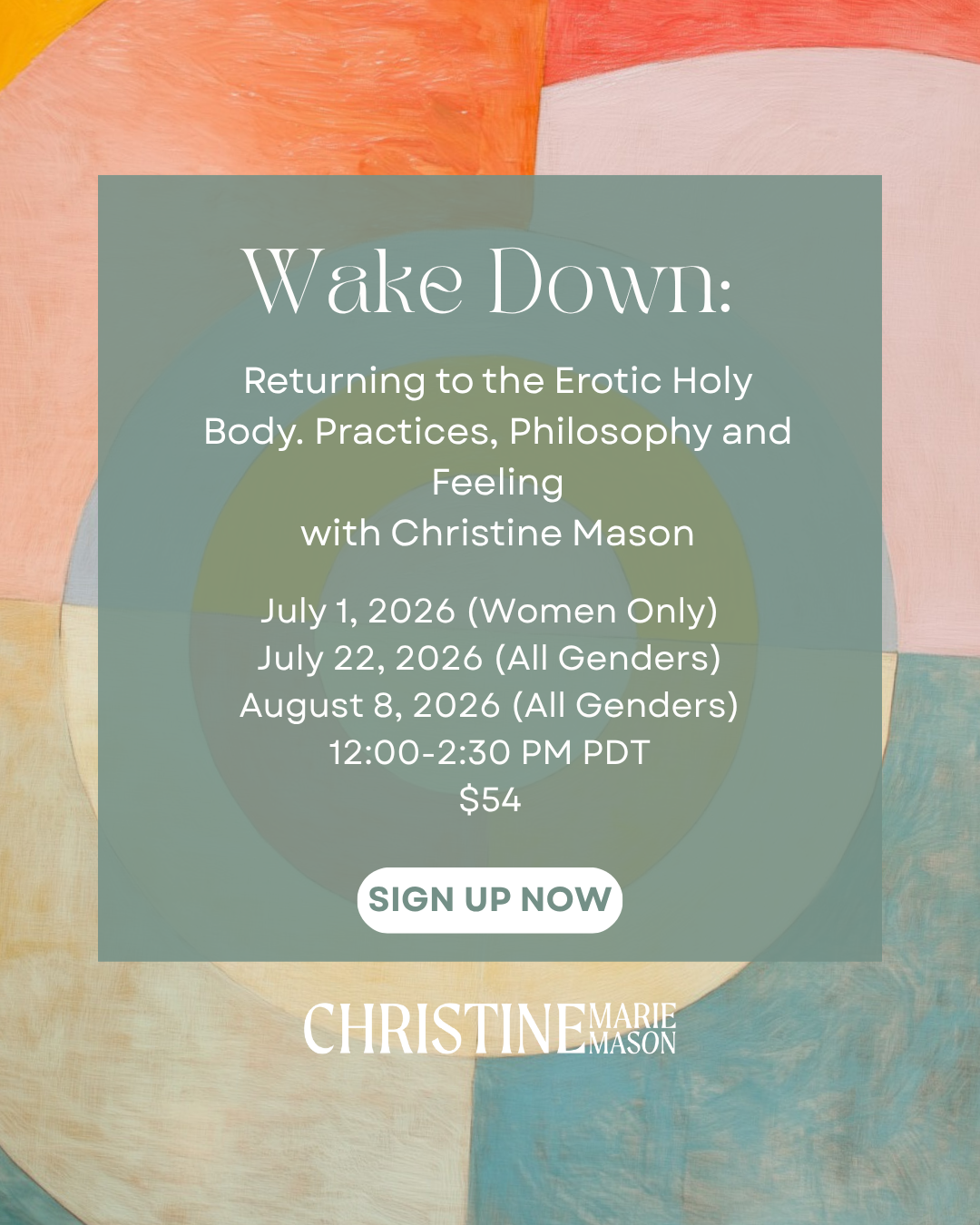
Last summer school drop-in class is this week (Saturday, August 8, 2026): Wake Down
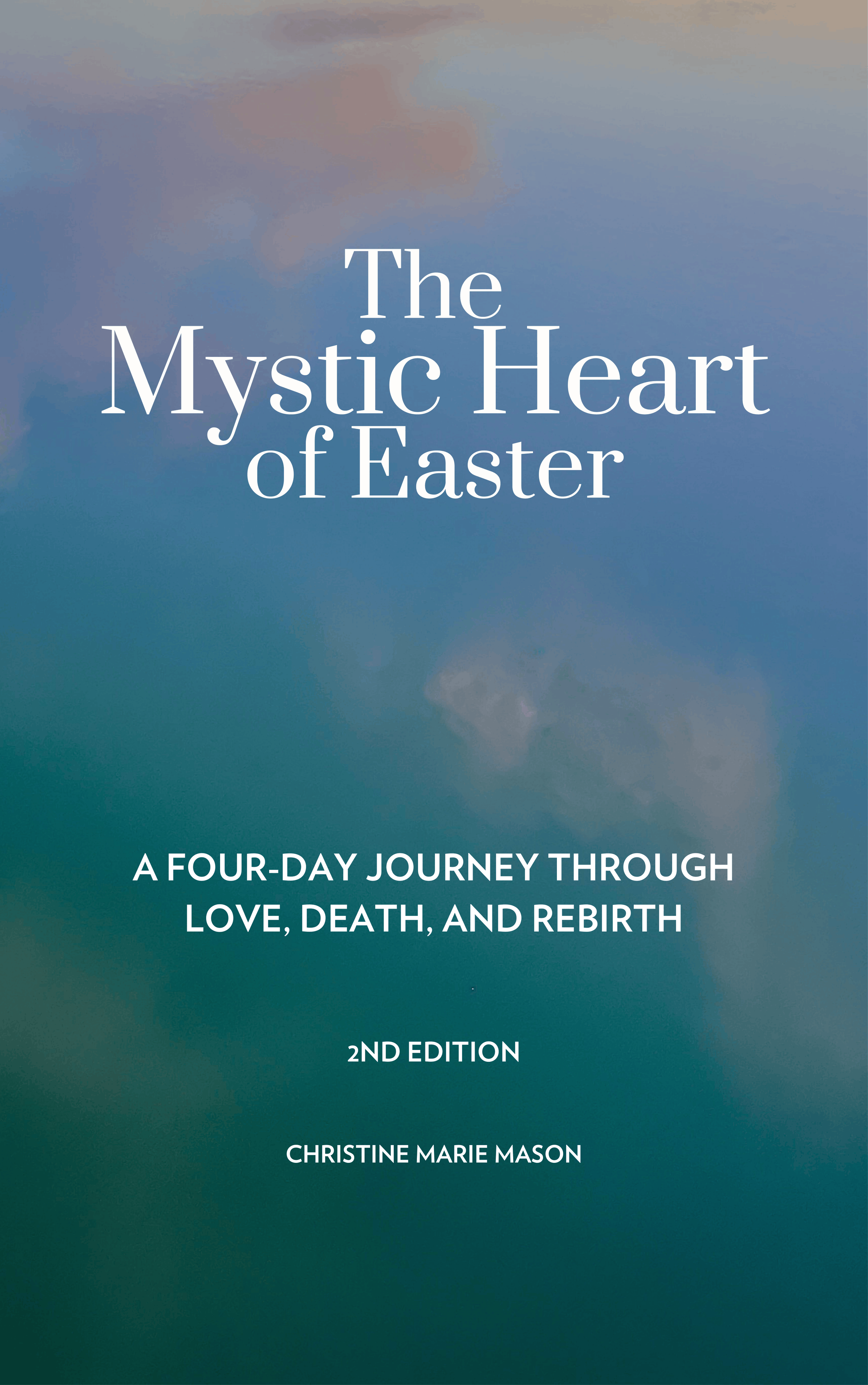
Just Released: 2nd Edition of the Mystic Heart of Easter
#1 New Release in Mysticism, now expanded in a Second Edition. Easter is a map of how transformation moves through every human life: love, death, the unbearable silence of not-knowing, and something rising that could not have been predicted from inside the dark.
The Mystic Heart of Easter guides you through the four most charged days of the Christian year — Maundy Thursday, Good Friday, Holy Saturday, and Easter Sunday — as a living practice rather than distant history. Drawing on Christian mysticism, Tantra, depth psychology, and contemplative practice, Christine Marie Mason walks beside you through each threshold with meditations, embodied practices, and the voices of fellow travelers.
New in the Second Edition:
The Passion Walk — a walking meditation through all fourteen Stations of the Cross, each read through four lenses: moral, political, esoteric and Tantric, and depth psychology. A portable pilgrimage for Holy Week or any season of loss.
Pentecost: The Overlooked 50-Day Map — a complete new chapter on integrating shattering experience, tracing the six movements the tradition gives us for moving from the locked room to the open street. For anyone metabolizing grief, ending, or awakening.
Also new: an editorial preface on the author’s forty-year journey through the tradition, refinements throughout, and larger print for comfortable reading.
For anyone navigating loss, uncertainty, or rebirth.
Subscribe to The Museletter
By Christine Marie Mason · Launched 3 years ago
Love & Liberation.
