What Does it Mean to be Transparent to the Light?
Cultivating the Light Body. Plus a nerdy outtake on gothic architecture.
My friend and teacher Patrick Connor uses a phrase I’ve loved for years: becoming transparent to the light. It’s gorgeous language and mystical enough that one can nod along to it for a long time, before inquiring into how it really works, or what it really means in practical terms.
In the work we do together, this “becoming transparent” mostly means clearing the accumulated debris of a human life, sometimes multiple lifetimes, making nothing wrong, and bowing to the unfathomable whole. To be willing to see everything. To ask for support. Sometimes the clearing is complete and immediate, sometimes layered and long and careful.
The way I experience it is as a sort of sediment or occlusion that are common to being human. Things like unexpressed or disenfranchised grief, swallowed anger, family patterns and beliefs we adapted to, or event the conclusions we drew about ourselves and how one should be when we were in the single-digit years make a sort of sheath over our essence, authenticity, insight and joy. This veil dims how much of the light can shine through us.
Initially, I thought of it as a transparent window, with myself or you as the window. The sunlight arrives from far beyond it, passes through unclaimed, and lands where it lands; the glass simply lets it through. When the glass is clean, light pours through and fills the room. When the glass is dirty, the room dims, and the problem is always, only, the glass.
The light, in this sense, might be the warmth you feel around people the ones who leave you feeling more like yourself, or what moves through a room when someone tells the truth kindly, or the aliveness in music, or the sweetness in the loving gaze. It’s the love that rests in its permanent abode inside of every heart, behind the masks and adaptations.
The dirt on the glass isn’t just unprocessed things, it can also be the little-s self doing what the self does: trying to matter. Wanting credit. Wanting to be seen as the source of the good thing rather than a place it passed through. The moment I think I gave her that insight, I healed him, I brought the light into that room rather than I was a channel for something else to come through, then the glass is smudged.
Other distortions include things like being loving but only toward people who earn it. Offering warmth the way a bank offers loans, that’s to say after a credit check, instead of just because you are the sun. Goodness as currency. However, Sol shines on every field before checking whether the field was worthy of morning. When kindness becomes a bargaining chip, it’s a dimmer switch. Generating the light is the sun’s job. Every exhausted helper, every burnt-out parent and teacher and healer that has thought their goodness had to be pumped out of a personal reserve that kept running dry might be relieved here.
Transparency returns the supply to its true source. Your job is smaller and much more possible: keep the glass clean, and the radiance will show through.
Who Wants to Be a Pane of Glass?
But frankly, who wants to be a pane of glass? We took birth for the flavor of it. Each of us came in with a perspective, a temperament, a particular mood of soul. If transparency meant erasing all that, then the most realized people on earth would be the most generic, yet they are the most unmistakable people who ever lived, each more herself, more himself, than anyone else in the room. A true teaching has to account for that.
So I amended the image to stained glass.
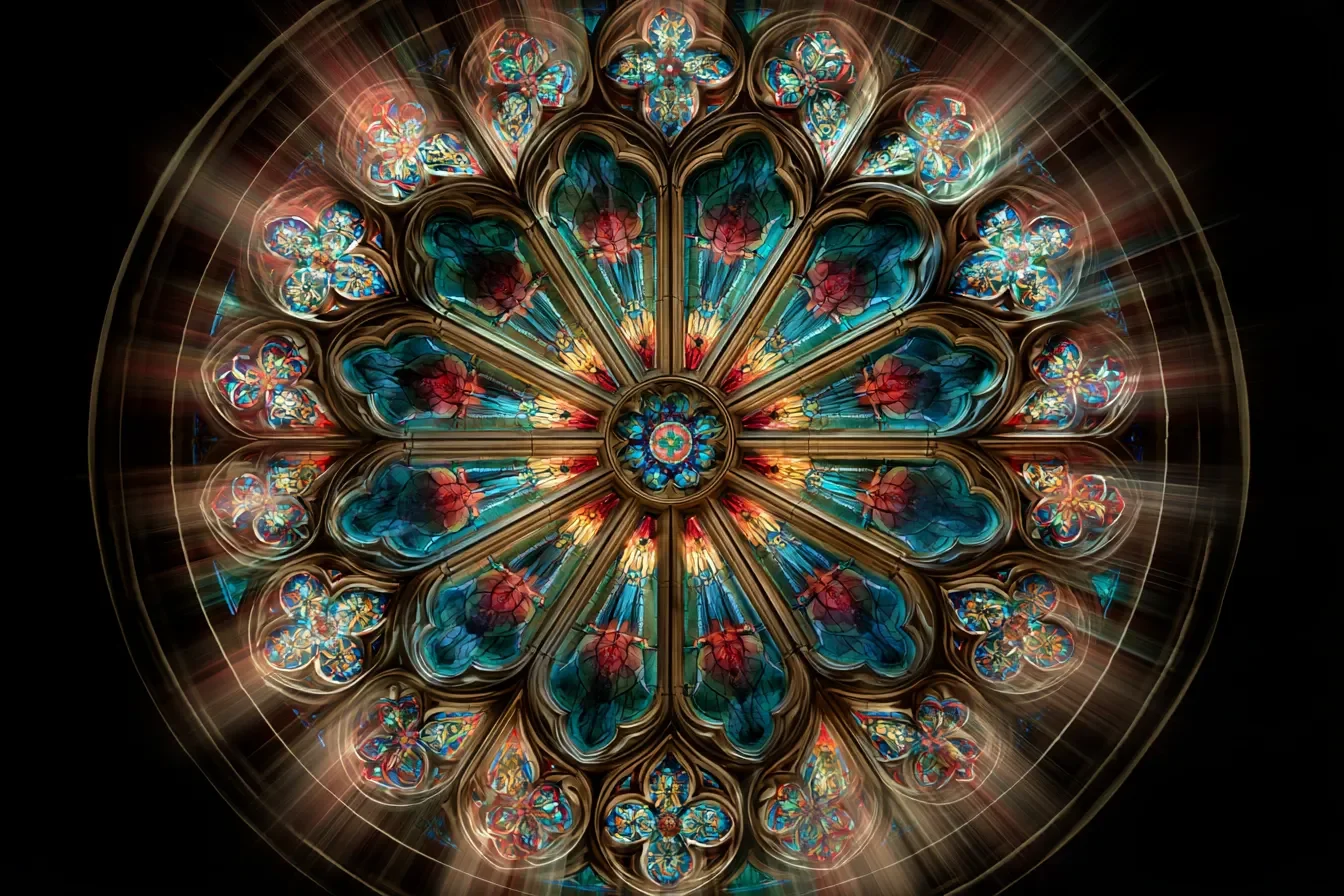
From a young age I lived and traveled in western Europe, and the light in the churches always mesmerized me. Nave after nave where colored glass turned ordinary sun into something you could stand inside. In 1984, in an art and architecture course in the south of France, our class went up to Paris and I saw Notre-Dame for the first time. Standing beneath the great rose windows, illuminated and streaming, the whole cathedral seemed to tone one long struck-bell note of color and I stood in it elated.
Decades later, Gaudí’s Sagrada Família in Barcelona took me the same way in another era’s language: light pouring through glass the colors of forest on the morning side and fire toward evening. Two buildings, seven hundred years apart, teaching the same physics of the holy: the color becomes visible only when light passes through it. At night, those great roses are dark walls of lead and shadow; at the first crossing of sun, they bloom.
Which turns the whole worry inside out: transparency is the condition under which your flavor finally becomes radiant instead of merely opaque. The particular reds and golds of you were never the smudge. The smudge was the grasping, the fear, the clutch of self-protection, the part of the pane trying to be the sun.
The medieval builders took sand and ash, the commonest, heaviest stuff of earth, and melted it in fierce heat until it comes out transparent. To the Gothic mind this was theology you could touch: coarse worldly matter, refined by fire until it could hold divine light.
Consider what that says about the sediment we carry. The debris of a life is the raw material of the pane. Fired and cleared, your griefs, your errors, your strange inheritances become the very glass the light comes through. The depth in your color, the reason your window glows like no one else’s.
Abbot Suger, who dreamed the first Gothic cathedral into being, taught that raw sunlight was too much for human eyes, as it was divine energy at full strength, while colored glass gentled it into a glow a person could stand inside. He called it lux nova, the new light. Your particularity, your flavor is where the infinite becomes meetable, here in a body. Someone can stand in the light because it comes through you.1
If the stained glass idea isn’t working for you, say it with music: every instrument is hollow. The emptiness is what allows the tone. It is the shape of the hollowness that makes its sounding. A cello and a flute are equally empty, and anyone can tell them apart blindfolded. You were carved into this particular shape so that when the breath moves through, it sounds like nothing else in the orchestra. Your soul timbre, one of a kind.
Here’s the useful distinction: flavor versus filter. A flavor is a perspective held open this vantage, this warmth, this way of loving, offered freely. A filter is the same particularity clutched and defended, insisted upon as the truth rather than one window onto it.
And here is the strange, happy evidence: as the gripping unwinds, people become more distinct. Fear looks the same on everyone; defensiveness looks the same on everyone; the ego is the great homogenizer. Take it away and what remains is wildly individual. People are funnier, stranger and more specifically themselves. The personality comes out in full.
How the glass actually gets clean.
Gently. Scrubbing at yourself in disgust only adds grime. That’s the self attacking the self, one more layer of the same.
The cleaning looks like this.
Honesty, first and always, as much as possible. Letting your worst moments be seen (by yourself, at minimum, and eventually by someone safe) free of the frantic project of proving them away. Whatever you refuse to look at hardens into another opaque patch, or solidifies. This is that “what you resist persists” meme. Whatever you can meet can go clear.
Letting old things finish. So much of the debris is simply a feeling that got interrupted and stuffed. Grief that never got its tears, anger that never got its voice, fear that never got to shake itself out. Permission to complete works much better than analysis. The body knows how, given space and safety to look and allow.
Including what you exiled. Every part of yourself you’ve pushed away. The needy part, the jealous part, the ravenous, the super cunt… is pressed against the glass from the inside waiting to be included. Blessing and, welcoming it home dissolves it.
Resting and receiving. The hardest one for me. Straining is itself a smudge. The deepest releasing happens beneath the intellect entirely. Understanding your patterns is a pointer, but the journey itself takes place in the body, and the thinking mind can only watch. You might be able to name your childhood wound with perfect accuracy for thirty years and the glass stays exactly as it was, because insight lives upstairs, and the grime lives in the tissues, in the breath, in the way the whole system braces against life. The kind of rest where every defense finally stands down and the body drops below its own vigilance into something like the deep of sleep while some tender awareness stays home.
In that state, healing happens the way a bone knits or a wound closes in the night: beneath your attention, precisely because your attention has stepped aside. The repair is a natural movement, and rest is an enabling condition.
This is also why certain rooms, certain teachers, certain kinds of quiet matter so much. Some people carry an atmosphere of rest the way others carry tension. You feel your shoulders drop just sitting near them, your breath lengthen, your system unclench in places you had stopped noticing were clenched. Whatever you want to call what happens in that depth of stillness, like grace or love, it works on you the way spring works on a frozen river: from underneath, at its own pace, with an intelligence that owes nothing to your understanding. You come up from those depths and something has moved. No notes needed.
And one more truth about the cleaning: it is lifelong. Life keeps depositing its sediment … new griefs, new fears, fresh conclusions forming even now about who we are and what we can expect from the world. We get better at meeting it in real time.
The real choice in front of a human being, at every age, is between clearing and ossifying: glass left untended goes opaque, and a pane that stops transmitting hardens into a wall. No light coming through at all.
I find this the opposite of discouraging. A practice you could finish is a practice you would eventually abandon; a practice that walks with you to the end of your life is a companion.
What it takes
It takes bravery. You will see things about yourself you have spent a lifetime arranging to avoid, and you will have to stay at the window anyway.
It takes appetite. Appetite, rather than duty or self-improvement or one more program of becoming acceptable: a frank hunger for more aliveness, more color, more of your own light in your own life. The people who go far on this path are the ones most in love with what’s possible.
AND it takes community, because your own glass is the one pane you can never quite see. Your smudges sit precisely in your blind spots. That’s what makes them yours. We need other eyes, other panes beside us in the same wall, people who can say there, that patch, right there with enough love that we can bear to look. And something else happens in a room of people clearing together: the light coming through each one makes it easier to trust the light in yourself. It takes many windows to make a cathedral.
You are not the sun and what a relief. Nor are you clear glass and what a joy. You are a particular pane of impossible color, still changing, and the light loves to know what life looks like as you.
The Tantric View on Cultivating the Light Body
The concept of a "light body"—a subtle, luminous form underlying or replacing the ordinary physical body—appears across multiple tantric and yogic lineages, though the terminology and specific practices vary. This summary traces the concept through several key texts and is a pointer to practices that cultivate that in modern life.
The light body practices and summary are reserved for paid subscribers. We are also covering them in week 2 of Living Tantra 101, which starts tomorrow, 9/15/26. XO CMM
The Foundational Concept
In classical Indian philosophy, consciousness itself (cit) is described as inherently luminous. Kashmir Shaivism names this quality prakāśa—variously translated as “light,” “luminosity,” or “shining forth.” Abhinavagupta (c. 950–1016 CE), the great systematizer of Kashmir Shaivism, states in his Tantrāloka that “consciousness is formed of light and beatitude.”¹ This is not metaphor: for this tradition, awareness is literally self-illuminating, and what we call “matter” is condensed light. The goal of practice, then, is not to create a light body but to recognize and refine access to what is already present.
The Vijñāna Bhairava Tantra: Practices of Luminous Awareness
The Vijñāna Bhairava Tantra (c. 8th–9th century), a foundational text of 112 meditation techniques, contains several practices that directly work with light and the transformation of body-sense:
Verse 52 instructs the practitioner to visualize the body being consumed by the “fire of time” (kālāgni) rising from the feet. At the end of this process, the text says, one attains “the radiant shining of pure tranquility.”²
Verse 65 instructs: “Remember the whole universe or your own body as filled with your own bliss. Through one’s own nectar (svāmṛta), one becomes filled with supreme bliss.”³
Another practice directs the meditator to see the body as empty space, or to contemplate the body as a form of light.⁴ These are not elaborate visualizations but rather shifts in attention recognizing the body’s nature as already luminous or spacious.
The Netra Tantra: Flooding the Body with Nectar
The Netra Tantra (c. 8th–9th century), focused on the worship of Amṛteśa (Śiva as Lord of Immortality), contains a section in Chapter 7 (verses 45–53) titled “Flooding the Body with Nectar” (amṛtaplāvana).⁵ The deity Amṛteśa is described in Chapter 9 of the same text as “pure, like crystal” (sphaṭikavat).⁶
The Tamil Siddha Tradition: The Divine Body (Divya Deha)
The Tamil Siddha tradition offers perhaps the most explicit descriptions of progressive body transformation. Siddha literature distinguishes several stages:
Sthūla deha: the gross, undisciplined physical body
Yoga deha: the body refined through practice
Siddha deha: the perfected body
Divya deha (also called jñāna deha): the divine body, “the body of light” (oli udambu in Tamil)
The divya deha is called cinmaya ”made of consciousness.” It’s described as “a body of infinite space” (vettaveli). At this stage, “every hair shaft in the body glistens and glows.”⁸ Sivavakkiyar, the Tamil Siddha poet, compares this transformation to “a worm turning itself into a butterfly.”⁹
Haṭha Yoga: Preserving the Nectar
The Haṭha Yoga Pradīpikā (c. 15th century) describes amṛta (nectar) as descending from the “inner moon” at the crown of the head. Normally this nectar is consumed by the digestive fire, contributing to aging. Practices such as khecarī mudrā (the tongue lock), viparīta karaṇī (inverted postures), and jālandhara bandha are said to preserve or redirect this subtle essence.¹⁰ This model connects the light body to practical physiology: by redirecting subtle essences upward rather than allowing them to dissipate, the gross body is gradually refined.
The Nāth Tradition: Siddha Siddhānta Paddhati
The Siddha Siddhānta Paddhati systematically presents the body as microcosm. The text describes “the lights of consciousness” dwelling within the body and the human frame as containing all sacred places and energies.¹¹
What the Texts Actually Prescribe (All of these are covered in Living Tantra 101 interactively)
Across these traditions, the practices that cultivate the light body include:
Breath practices (prāṇāyāma) that purify the subtle channels
Visualization of light, fire, or nectar pervading the body
Mudrās and bandhas that redirect subtle essences upward
Contemplative awareness of the body as space, light, or bliss
Devotional intensity (bhakti) that transforms the heart
Lifestyle supports: simplicity of inputs in multiple domains.
The goal is recognition and then stabilization of that recognition until it becomes the baseline of embodied experience.
Notes on Sources
¹ Abhinavagupta, Tantrāloka. English translation: John Hughes, ed., Light on Tantra in Kashmir Shaivism: Chapter One of Abhinavagupta’s Tantraloka (Universal Shaiva Fellowship, 2017). See also the Italian translation by Raniero Gnoli, Luce dei Tantra (1999).
² Vijñāna Bhairava Tantra, verse 52. Multiple translations available, including Jaideva Singh’s Vijñānabhairava or Divine Consciousness (Motilal Banarsidass, 1979) and Lorin Roche’s poetic rendering The Radiance Sutras (2014). Sanskrit and translations at hareesh.org.
³ Vijñāna Bhairava Tantra, verse 65. See Singh, 1979.
⁴ See Sally Kempton’s compiled translations at sallykempton.com; Christopher Wallis (Hareesh) at hareesh.org provides scholarly commentary.
⁵ Netra Tantra, Chapter 7. Bettina Baumer, The Yoga of Netra Tantra (D.K. Printworld, 2019). See also Gavin Flood et al., “The Lord of Immortality: An Introduction, Critical Edition, and Translation of the Netra Tantra, Chapter 7” (Oxford Centre for Hindu Studies, 2019).
⁶ Netra Tantra, Chapter 9 summary, per Baumer.
⁷ Netra Tantra, Chapter 7. Bettina Baumer, The Yoga of Netra Tantra: Third Eye and Overcoming Death (D.K. Printworld, 2019). Chapter 7 deals with sūkṣma-dhyāna (subtle yoga), including sections on creating a divine body, khecarī-mudrā, and “Flooding the Body with Nectar” (verses 45–53). The chapter enumerates the six cakras, sixteen ādhāras, and the nāḍīs, and may have influenced the later Siddha Siddhānta Paddhati. I have not personally verified the translations; this summary draws on the publisher’s table of contents and secondary scholarly descriptions.
⁸ Tamil Yoga Siddha Research Project, Babaji’s Kriya Yoga. See also T. N. Ganapathy, The Philosophy of the Tamil Siddhas.
⁹ Sivavakkiyar, in Tamil Siddha literature. See Ganapathy.
¹⁰ Haṭha Yoga Pradīpikā, Chapter 3. Swami Satyananda Saraswati’s commentary edition provides detailed explanation.
¹¹ Siddha Siddhānta Paddhati. See Dr. M. L. Gharote, ed. (Lonavala Yoga Institute); also Kalyani Mallik, Siddha Siddhānta Paddhati and Other Works of the Nath Yogis (1953).
MORE ON ROSE WINDOWS, ALL Y’ALL NERDY PEOPLE WHO ARE STILL READING:
For readers who want to stand a little longer in the nave. The medieval builders encoded an entire cosmology in the rose window. The window is a map of the cosmos, a marriage of heaven and earth, a clock of sacred time, a lesson in transfiguration, and a preview of paradise — all before a single Bible story is read in the panes. The medieval church understood something we are only now remembering: that light through colored glass teaches the deepest things wordlessly, to anyone who stands in it.
Strip away the painted stories and the rose window is a mandala in stone. At its exact center sits the divine source. It is unmoving, infinite, the origin point of all things. The stone tracery radiating outward is creation itself, manifestation expanding from that single point into the world of form. The outer circle is the created universe, bound in harmony, an echo of the medieval cosmos of concentric spheres.
To pray before the window was to look at a map of reality with God at the middle, and to find your own place somewhere along a spoke of light.
The circle, with its endless line, is the symbol of heaven. The circle stand for eternity, spirit, the divine realm. The square (ironically, not a flat earther, friends) is earth: four seasons, four elements, four cardinal directions, the world of matter and time. The rose window is almost always a vast circle set within a square bay of stone. The builders were stating, in architecture, the central mystery of their faith: the eternal descending into matter and dwelling there. Heaven set into earth. Incarnation, in load-bearing form.
The petal-count of a rose window was chosen with intention. Eight segments spoke of regeneration. The “eighth day” beyond the seven-day week, resurrection, the new creation. Twelve spoke of cosmic order and time: twelve months, twelve signs, twelve tribes and apostles, the whole calendar of existence turning around the divine center. Twenty-four doubled that order into total harmony, the old world and the new reconciled in a single wheel. Time itself revolving around the light.
Preachers of the age loved a further subtlety: light passes through glass and leaves it intact. The sunbeam enters, the pane remains whole. This became a beloved metaphor for the Incarnation (spirit entering the world through Mary while leaving her unbroken, regardlesss of where we stand on the body denying legacy of that for women) and it carries a gentler, general truth: being moved through is harmless to the one who allows it.
The Book of Revelation describes heaven as a city of gold “clear as glass,” walled in sapphire, emerald, and ruby. The glassmakers took this literally. They saturated their glass with metal oxides — cobalt for blue, gold and copper for red — until the windows became walls of liquid gemstone. To step from the dark street into the nave was to rehearse the final promise: leaving the heavy earth and standing, for an hour, inside the glowing walls of heaven.
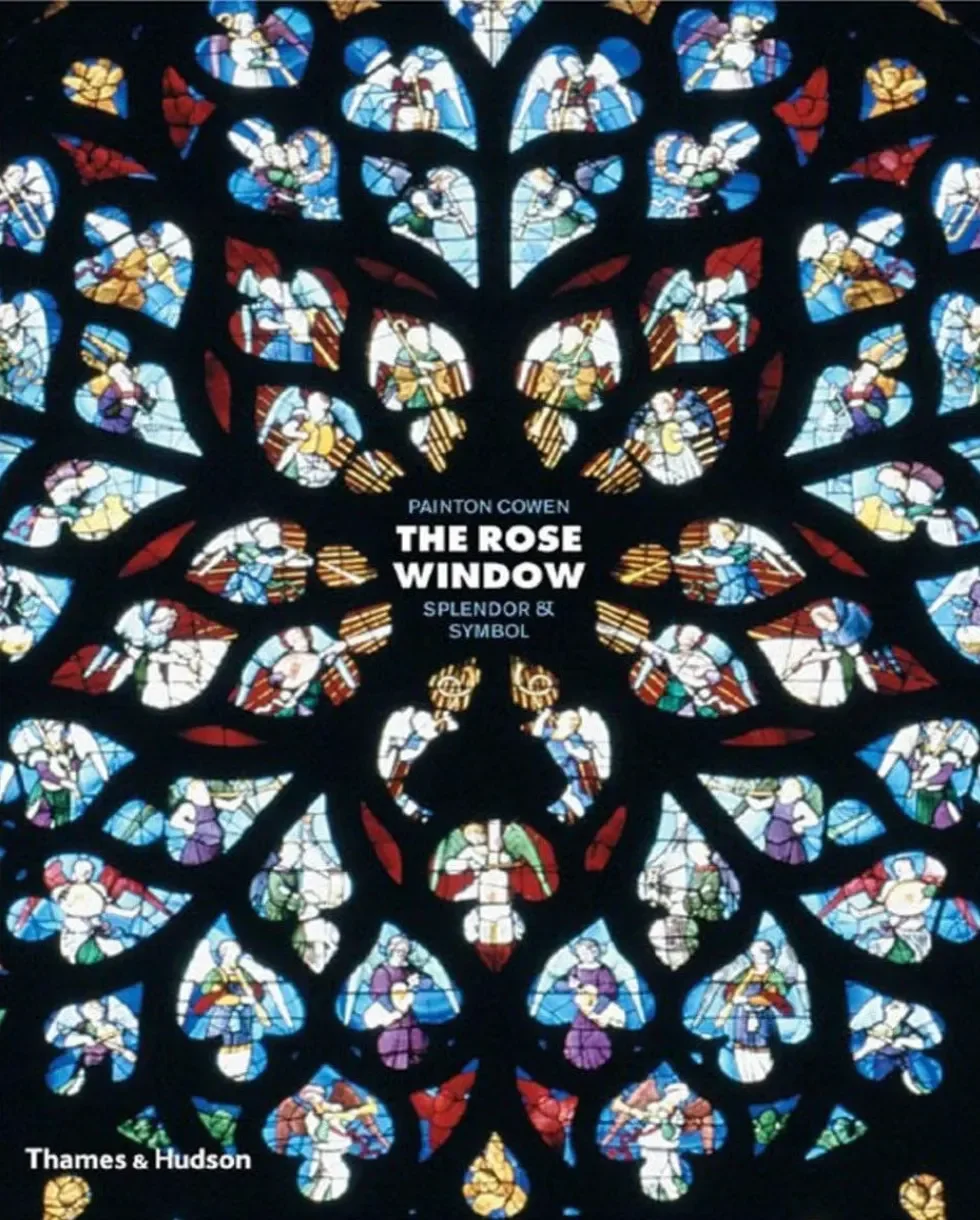
For more on this, there is a classical hardback photography book with 300 rose windows you can find here.